Can You Use AI Music on YouTube? (Copyright & Money, 2026)
Yes, but four gates decide whether an AI song can earn money on YouTube: your license, copyright, YouTube's AI rules and Content ID. Full checklist inside.
Can You Use AI Music on YouTube? Copyright, Content ID and Monetization (2026)
AI music generators can write a full song with vocals in under a minute. For YouTubers, that sounds like the end of royalty-free library hunting and surprise copyright claims.
So, can you use AI music on YouTube? Yes. YouTube allows AI-generated music, and it can appear in monetized videos.
But whether a particular song is safe to upload, and whether it can earn money, depends on four separate things that most guides blur together.
This guide walks you through those four gates: your generator's license, copyright law, YouTube's own rules for AI content, and Content ID. Gates 2 to 4 are backed by official policy pages. Near the end there's a 10-point checklist to run before you publish.
One note first: this is a practical guide, not legal advice. Policies below were checked on October 21, 2026.
The short answer: can you use AI music on YouTube?
You can use AI-generated music on YouTube, including in monetized videos, if your generator's license allows commercial use, you disclose realistic AI music when YouTube asks for it, and your channel doesn't rely on mass-produced, repetitive uploads. In the US, a purely AI-generated song generally isn't protected by copyright, which changes what you can claim and register.
The rest of this guide explains each part of that answer.
The 4 Gates every AI song has to pass
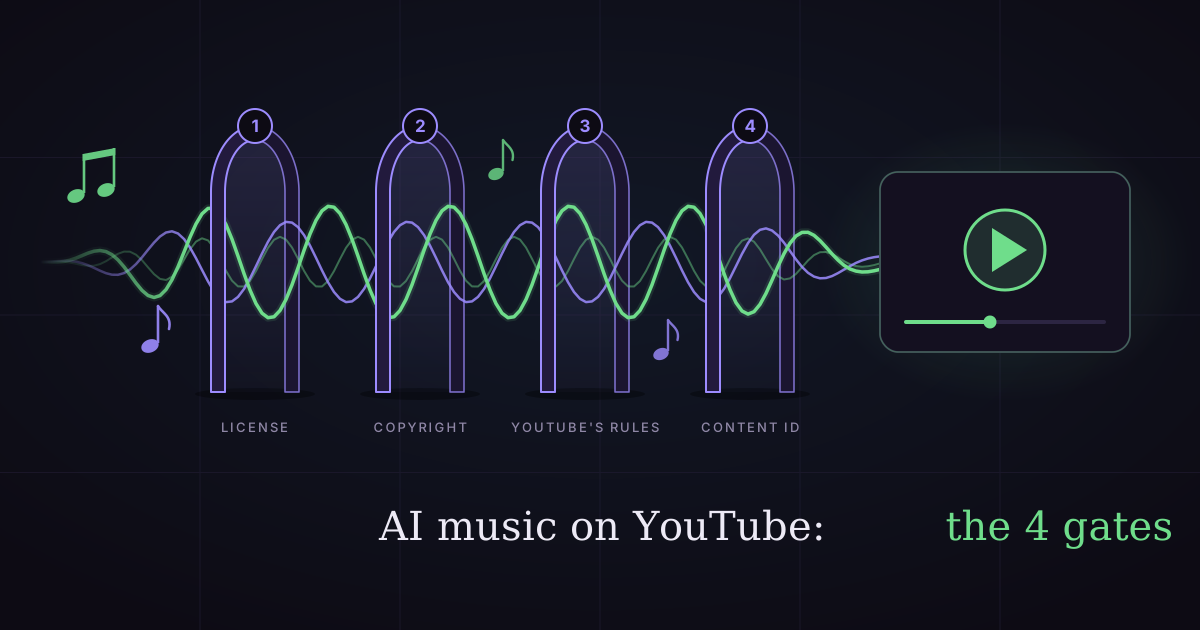
Think of every AI track as passing through four gates, in order: license, copyright, platform rules and Content ID. Fail any one, and the song can be muted, claimed, demonetized or removed.

| Gate | The question | Who decides |
|---|---|---|
| 1. License | Are you allowed to use this song commercially? | Your AI music generator's terms |
| 2. Copyright | Does anyone own a copyright in it, and can you? | Copyright law (US Copyright Office guidance) |
| 3. YouTube's rules | Do you need to disclose it, and can it be monetized? | YouTube's AI disclosure and YPP policies |
| 4. Content ID | Can it be claimed, and can you claim others? | YouTube's Content ID eligibility rules |
Most "can I use AI music" answers only cover one gate. That's why creators who did everything "right" still get surprised.
Let's take them one at a time.
Gate 1: your AI music generator's license
Your right to use an AI song comes first from the terms of the tool that made it. Copyright law and YouTube's rules only matter once the license says you can use the track at all.
Free plans vs paid plans
Many AI music tools give free users personal, non-commercial use only and grant commercial rights on paid plans. Read the terms for the plan you were on when you made the song.
Does upgrading later cover old songs?
Often it doesn't. Some tools grant commercial rights only to songs created while you were subscribed, so a track you made on a free plan stays non-commercial after you upgrade. If the terms don't say, assume it doesn't carry over.
What Imgveo's paid plans allow
Songs made with the Imgveo AI music generator on a paid plan can be used commercially: in your videos, ads, podcasts, games and social posts, including client work. The music generator is available on paid plans only, so every song it makes falls under those terms.
What's off-limits on Imgveo
On Imgveo, and under the platform rules covered below, three things are off-limits:
- Imitating a real singer's voice or passing a song off as a real artist's release
- Using lyrics you don't have the right to use, such as another artist's lyrics
- Prompting with real artists' names to copy their style; many tools refuse these prompts outright, and ours does too
Save the terms page (or a screenshot of it) on the day you make a song you plan to monetize. You'll want it if anyone ever asks.
Gate 2: can AI music be copyrighted?
In the United States, music generated entirely by AI is not protected by copyright, but the parts a human creates are. That's the position of the US Copyright Office, set out in its January 2025 report on copyrightability.
Purely AI-generated music isn't protected
The Copyright Office puts it plainly: "Copyright does not extend to purely AI-generated material, or material where there is insufficient human control over the expressive elements."
A prompt is not enough
Typing a prompt doesn't make you the author. In the same report, the Office concluded that "prompts do not alone provide sufficient control" over the result. Its 2023 registration guidance said the same about music: when a tool receives only a prompt, the "traditional elements of authorship" are executed by the technology.
Your own lyrics are yours
Human contributions are protected. The report says human authors are entitled to copyright in their work that is "perceptible in AI-generated outputs," and in creative selection, arrangement or modification of the output.
So if you write the lyrics yourself and use an AI tool to sing them, the lyrics are your copyrighted work, while the AI-generated melody and recording generally are not.
Registering a song that includes AI
If you register a work with the US Copyright Office, you have to disclose AI-generated content and explain the human contribution. More than a minimal amount of AI material must be excluded from the claim.
"Royalty-free" is not "copyright-free"
These two terms get mixed up constantly.
- Royalty-free means you may use a track without paying per use, under a license.
- Copyright-free means nobody owns a copyright in it.
An AI song can be both uncopyrightable and still governed by a license, because the generator's terms are a contract with you. Follow the license even if copyright doesn't apply.
Outside the US, rules differ by country. If a song matters to your business, ask a lawyer where you publish.

Gate 3: YouTube's rules for AI music
YouTube allows AI music, but it asks you to disclose realistic AI content and it won't pay channels built on mass-produced, repetitive videos. Both rules are in YouTube's official policy pages.
When you must disclose AI music
YouTube's disclosure policy lists music explicitly. Creators must disclose GenAI content that "creates music that's the main focus of the video," and "AI generated music" is one of YouTube's own examples of content that needs disclosure.
You disclose it in YouTube Studio when you upload, with the AI content setting in the video's details. For AI-generated music, YouTube may also show a label in the video player.
Disclosure doesn't hurt monetization
This is the part creators worry about most, and YouTube is clear: "Disclosing AI content alone won't limit a video's audience or impact its eligibility to earn money."
Not disclosing is the risk. Creators who consistently don't disclose may get a label applied for them, have content removed, or be suspended from the YouTube Partner Program.
When AI music is background only
The rule targets music that's the main focus of the video. A quiet AI track under your voice-over is a different case from a video that is the AI song. When in doubt, disclose: it costs you nothing.
The "inauthentic content" rule
On July 15, 2025, YouTube updated its monetization policy to make clear it covers content that is "repetitive or mass-produced," and renamed the policy from "repetitious content" to "inauthentic content."
The current policy says monetized content must "not be mass-produced, generic, repetitive, or manipulative." Among its examples of content that can't earn money: AI-generated content made with generic templates "without adding the creator's original, authentic insights or perspective."
What that means for AI music channels
A channel of AI songs over a still image, uploaded in bulk, is the exact pattern this rule targets. YouTube's policy also says channels "where content feels interchangeable from video to video" can't monetize.
Using AI music inside a video with your own footage, commentary or story is a different thing. The policy allows automated tools as long as the final video shows "your creative vision" and provides educational or entertainment value.
Voice cloning and artist mimicry
YouTube lets people request removal of AI content that simulates their face or voice through its privacy process. It also announced in November 2023 that music partners could request removal of AI music that mimics an artist's unique singing or rapping voice. Don't make songs that sound like a specific real singer.
Gate 4: Content ID
AI songs can trigger Content ID claims, and in most cases you can't register an AI song in Content ID yourself. Here's why both are true.

Why an AI song can get claimed
Content ID matches your upload against reference files from rights holders. If an AI track happens to sound close to a registered recording, or if someone else uploaded a similar AI track to a distributor that registered it, your video can be claimed.
Why you usually can't register AI music in Content ID
YouTube's eligibility rules require exclusive rights: "You must have exclusive rights to the material in the reference file for the territories where you claim ownership." Content licensed non-exclusively from a third party isn't eligible.
YouTube's page doesn't mention AI specifically. But a song you can't own a copyright in, generated under a non-exclusive license, doesn't meet the exclusive-rights test. Our reading is that most AI songs are not eligible for Content ID, and that registering them through a distributor creates claims you can't stand behind.
How to dispute a claim on your AI song
- Open the claim in YouTube Studio from the video's copyright details.
- Check the match. Listen to the matched segment. If it really is someone else's recording, remove or replace it.
- Dispute if you have the right to use the music. Choose the reason that fits, such as having a license, and explain that the track was generated by you with a commercial license.
- Attach your proof: the generator's terms, your plan at the time, and the date you made the song.
Keep a simple record for every AI track you publish: tool, plan, date, prompt or lyrics, and the downloaded file. It makes a dispute much quicker to answer.
Spotify and music distributors
Streaming services accept AI music, but they police spam and voice cloning, and distributors set their own rules. If you plan to release an AI song beyond YouTube, check this gate too.
Spotify
In September 2025, Spotify said it removed over 75 million spammy tracks in a year and announced a music spam filter. It allows vocal impersonation only "when the impersonated artist has authorized the usage," and it supports an industry standard (DDEX) for AI disclosures in music credits.
Distributors
| Distributor | AI music policy (official help pages) |
|---|---|
| DistroKid | Accepts music made with AI tools if you own 100% of the rights and the song doesn't mimic someone's voice without permission |
| TuneCore | Distributes GenAI music only if the models were trained on fully licensed datasets |
| CD Baby | Doesn't accept AI-generated content, even if commercially licensed |
DistroKid also passes AI credits to Spotify, Apple Music and YouTube, which show them to listeners. Before you upload to a distributor with training-data rules, confirm in writing that your tool meets them.
The lawsuits behind these rules
Most of these policies were written while major record labels were suing AI music companies. The suits began in 2024.
By late 2025, several of those cases had settled into licensing deals, with the AI companies promising new models trained on licensed music. Others were still in court through 2026.
For creators, the practical effect is that terms keep changing. A tool's license today may not match the license you accepted a year ago. That's another reason to save the terms with every track.
Your pre-publish checklist for AI music
Run these 10 checks before you upload a video with AI music. Every one maps to one of the four gates.

- The song was made on a plan that allows commercial use.
- You saved the terms and the date you made it.
- No real artist's name was in the prompt, and the voice doesn't imitate a real singer.
- The lyrics are yours or you have the right to use them.
- You listened for resemblance to a song you know. If it sounds close, regenerate.
- You'll disclose if the AI music is the main focus of the video.
- The video adds something of yours: footage, commentary, story or editing, not a still image and a loop.
- You're not uploading in bulk from the same template.
- You won't register the track in Content ID unless you're certain you hold exclusive rights.
- You kept your records: tool, plan, date, prompt or lyrics and the file.
How to use AI music in your YouTube videos
AI music works best as part of a video you made, not as the whole video. Here are four low-risk uses.
Background music under a voice-over
Generate an instrumental in the mood of your video, set the length to match, and keep it low under your voice. This is the lowest-risk use, because the music isn't the main focus of the video.
Intros, outros and stingers
A 30-second branded intro made in Lyrics mode gives your channel a recognizable sound. Use the same track on every video and keep the file and terms on record.
Shorts and vertical videos
Short-form edits often need a track that starts on the beat. Generate a few takes and cut the one whose first seconds hit hardest.
Faceless and narrated channels
If your channel runs on AI visuals and narration, the inauthentic content rule matters most. Our guide to starting a faceless YouTube channel with AI covers how to add enough of your own work to stay monetizable.
On Imgveo, a music run costs 20 credits and returns two full songs, as MP3s with cover art. Describe mode writes the lyrics for you; Lyrics mode sings your own words at a length from 30 seconds to 4 minutes. You can make a soundtrack with the AI music generator and pair it with a clip from text to video.
FAQ
Can I use AI-generated music on YouTube?
Yes. YouTube allows AI-generated music, including in monetized videos, as long as your generator's license allows commercial use. Disclose it when the AI music is the main focus of the video.
Can you monetize AI music on YouTube?
Yes, if the video meets the YouTube Partner Program rules. YouTube says disclosing AI content doesn't affect eligibility to earn money. What blocks monetization is mass-produced, repetitive content, such as bulk uploads of AI songs over still images.
Is AI-generated music copyright free?
Not exactly. In the US, purely AI-generated music generally isn't protected by copyright, but your use is still governed by the tool's license. Lyrics you wrote yourself are protected.
Can AI music get a Content ID claim?
Yes. If an AI track sounds like a registered recording, or someone registered a similar track, Content ID can claim it. Dispute with proof of your license if the claim is wrong.
Can I copyright a song made with AI?
You can register the parts a human created, such as your own lyrics or a creative arrangement. The US Copyright Office says prompts alone aren't enough, and purely AI-generated material isn't protected. You must disclose AI content when you register.
Do I have to disclose AI music on YouTube?
Yes, when AI-generated music is the main focus of your video. YouTube lists "AI generated music" as an example that needs disclosure, and disclosing it doesn't limit reach or monetization.
The bottom line
AI music is allowed on YouTube and can earn money, as long as it passes all four gates: a commercial license, a clear view of who owns what, YouTube's disclosure and inauthentic content rules, and Content ID. Most problems come from skipping one gate, not from AI music itself.
Make the song on a plan that allows commercial use, add your own work around it, disclose when it's the focus, and keep your records. When you're ready, create your first track with the AI music generator.
This article explains public policies as of October 21, 2026, and isn't legal advice. For a specific release or contract, talk to a lawyer.
Sources
- YouTube Help: Disclosing use of GenAI content
- YouTube Help: YouTube channel monetization policies
- YouTube Help: Content eligible for Content ID
- YouTube Official Blog: Our approach to responsible AI innovation (November 14, 2023)
- US Copyright Office: Copyright and Artificial Intelligence, Part 2: Copyrightability (January 29, 2025)
- US Copyright Office: Registration guidance for works containing AI-generated material (March 2023)
- Spotify: Spotify strengthens AI protections (September 25, 2025)
- DistroKid Help: Can I upload music made with AI tools? and What are AI credits?
- TuneCore Help: GenAI music content framework
- CD Baby Help: Understanding production sounds
Related reading
Author

Categories
More Posts

AI Video Credits Explained: What 1 Clip Costs on 5 Platforms
Pollo, Higgsfield, PixVerse, Kling and Imgveo all sell credits — but a credit isn't a clip. Here's the exchange-rate math for what one 5-second video really costs.

Runway vs Pika (2026): Which AI Video Tool Wins?
Runway vs Pika compared for 2026 — quality, speed, control, and pricing. See which AI video generator fits your work, with a clear winner for each use case.

Best AI Video Generators With Native Audio (2026 Compared)
Which AI video generators produce sound — dialogue, SFX, ambience, music — in one pass? We compare Veo 3, Kling 3, Kling 2.6 and Seedance 2, plus what audio adds to the bill.